For many learners in low-resource schools, opportunities for sport, exercise and even basic physical education are limited. But thanks to the Siyaphakama Project — a flagship outreach and research initiative — the tide is turning. Launched in 2022 and named after Springbok captain Siya Kolisi and his mother, Phakama, the project brings together physical activity, nutrition, education and mentorship to develop stronger, healthier and more confident learners. “Siyaphakama was born from the need to address the many challenges that young people in under-resourced areas face — from malnutrition and poor access to sport facilities, to limited opportunities for physical activity,” explains Dr Danielle Dolley, Postdoctoral Research Fellow and South African Project Coordinator of KaziBantu at Mandela University. The initiative supports six primary schools in Zwide, where learners and teachers receive support through quality physical education, workplace wellness and nutrition programmes — all developed in collaboration with the Kolisi Foundation, Ubuntu Pathways, United Through Sport and Mandela University.
Movement as a tool for change
At the heart of the project is a simple idea: movement heals, connects and teaches. “Movement is our vehicle for learning and growth,” says Dr Dolley. “Teachers and sport coordinator interns are trained through a short learning programme to deliver quality physical education even in resource-constrained schools.” The results are already visible. Foundation Phase learners are building fundamental movement skills — the essential building blocks for sports and everyday activity — while gaining a deeper understanding of health and wellness. Intermediate and Senior Phase learners explore how fitness and physical activity support emotional and social wellbeing. Sport coordinator interns from Zwide serve as mentors and role models, leading after-school sessions and inspiring learners while developing valuable skills and employment experience. “Each school has two interns who bring energy, structure, and hope to every session,” adds Dr Dolley.
Impact you can measure
The numbers speak volumes. Health screenings show a notable improvement in learners’ weight status, with fewer learners presenting as overweight and more falling within a healthy weight range. Through the Sport for Development component, several learners have earned bursaries to prestigious schools in Gqeberha — and new sports infrastructure, including a full-size artificial field and multipurpose court, has opened safe, accessible spaces for play. Teachers, ground staff, administrative employees and food preparers, too, are benefiting. The Workplace Wellness Programme has seen notable health improvements: physical activity levels improved, tobacco use declined, and high blood pressure rates fell. “These changes demonstrate how healthy teachers can inspire healthier schools,” says Dr Dolley.
Collaboration for community impact
Behind Siyaphakama is a powerful partnership network. The project is coordinated by the Kolisi Foundation, in partnership with Ubuntu Pathways, United Through Sport, and KaziBantu at Mandela University. It also falls under the UNESCO Chair on Physical Activity and Health in Educational Settings, a collaboration between Mandela University, the University of Basel in Switzerland and the Swiss Tropical and Public Health Institute. Within the University, the Departments of Human Movement Science and Human Nutrition and Dietetics work side-by-side, ensuring that learners benefit not just from movement education, but also from proper nutrition and hygiene training. “Students gain real-world, work-integrated experience through Siyaphakama,” says Dr Dolley. “They apply what they’ve learned while contributing directly to social change — a hallmark of Mandela University’s humanising pedagogy.”
Research that drives real change
Siyaphakama is as much a research project as it is a community initiative. Data from participating schools are used to evaluate physical literacy, health, and nutrition, while findings directly inform teacher training. A 2024 master’s study found that while learners were physically active, meeting the recommended 60 minutes of daily physical activity, many lacked proficiency in fundamental movement skills. “It highlights the need for structured physical education for learners and the in-service training of teachers,” says Dr Dolley. “Our findings feed directly back into training programmes to ensure that teaching becomes more purposeful and effective.” School and community kitchen food preparers have also shown creativity after nutrition workshops — establishing vegetable gardens, repurposing materials for food storage, and introducing preparation methods that improve both health and learning.
A model for transformation
For Dr Dolley, the project perfectly captures the spirit of Nelson Mandela University’s mission. “Siyaphakama embodies our vision of changing the world through education,” she says. “It’s about creating equitable access to quality physical education, promoting wellbeing, and building community resilience.” Looking ahead, the team hopes to expand the model to more schools and strengthen teacher training across the Eastern Cape. “Our long-term goal is to inspire a generation of learners and educators who value movement, wellbeing, and collective growth.”
For more information about The Siyaphakama Project, please visit UNESCO Chair, Kazibantu and UNESCO QPE
At a Glance — The Siyaphakama Project
- Launched: 2022
- Meaning: “We Are Rising” (named after Siya Kolisi and his mother, Phakama)
- Partners: Kolisi Foundation, Ubuntu Pathways, United Through Sport, KaziBantu at Mandela University, University of Basel, and Swiss Tropical and Public Health Institute
- Schools supported: 6 primary schools in Zwide
- Impact highlights:
–rise in learners who fall within healthy weight range
–drop in overweight learners
– drop in hypertension among teachers
– New artificial field and multipurpose court for safe play
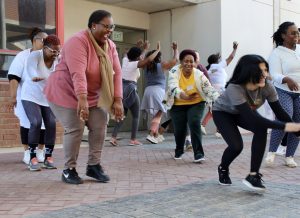
MOTIVATED TO MOVE: Teachers participating in an energising physical activity session during the Physical Education professional development workshop at Nelson Mandela University.
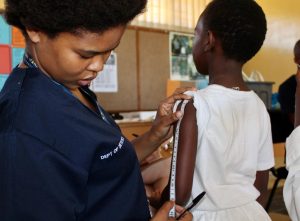
HEALTH IN ACTION: A student from the Department of Human Nutrition and Dietetics conducting an assessment at a Zwide primary school as part of the Siyaphakama health screening initiative.
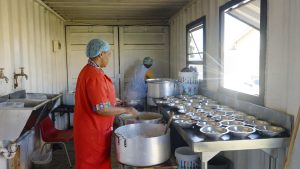
FIRM FOUNDATION: School food preparers serving nutritious hot meals as part of the school nutrition programme.
Original Article: https://news.mandela.ac.za/News/Mandela-University%E2%80%99s-Siyaphakama-Project-partnersh